Showing posts with label Grief. Show all posts

Friday, February 24, 2023

Body Language Analysis No. 4673: One Year On. It's been a year since Russia's full scale Invasion of Ukraine. President Volodymyr Zelenskyy's agony and grief in Bucha.


In the above image, President Zelenskyy is seen on 4 April 2022, witnessing the aftermath of murder and torture unarmed Ukrainians civilians — including children, the elderly, and women — by Russian soldiers in Bucha.


In this close-up image, we are able to see somewhat greater facial detail. In the central portion of President Zelenskyy's forehead, the  juxtaposition of two superficial muscles are manifested (Photo: AFP, Anadolu Agency/Getty Images).


The horizontal furrows (signifying temporary muscle contraction) in the mid-level of the central forehead are formed by active contraction of the frontalis pars medialis. These muscles are pulling upward (superiorly).


The vertical furrows in the lower portion of President Zelenskyy's central forehead are formed by contractions of the depressor glabellae, depressor supercilii, and corrugator supercilii. These muscle contractions are pulling downward (inferiorly) and inward (medially).
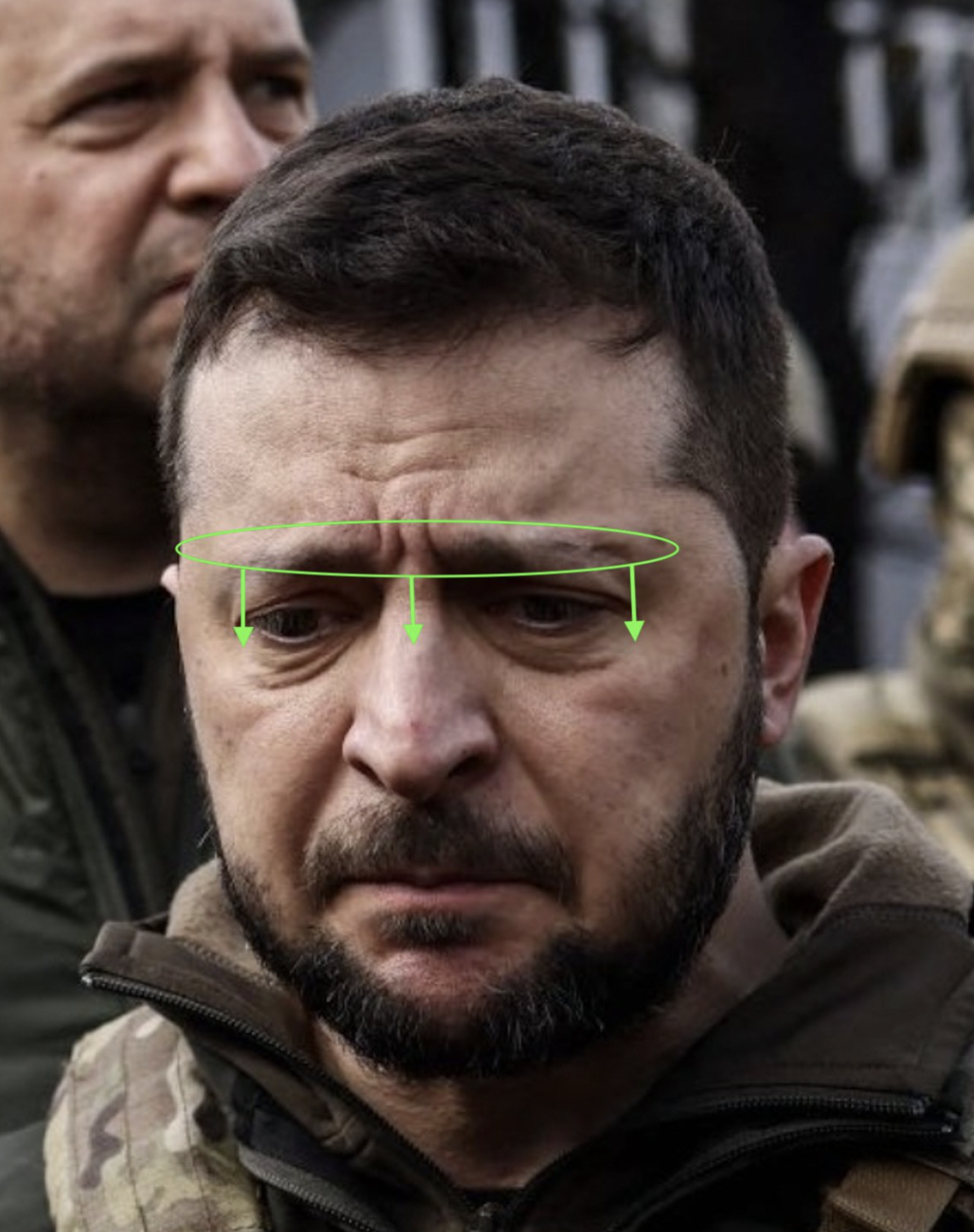


In addition, the entire width of the lower forehead, including each eyebrow, is also contracted — vectoring downward, hooding a portion of his eyelids.


President Zelenskyy is looking down and to his right (he may, of course, be looking at bodies of the deceased). Of particular note, the right lower quadrant (his right) is the direction we most often look when we're trying to emotionally process grief, sadness, and agony.

President Zelenskyy's upper eyelids as well as his lower eyelids are partially actively closed (not 'droopy' but actively contracted).

The corners of President Zelenskyy's mouth are also down-turned. His nostrils are flared and his 'mustache area' is also contracted (primarily vertically, but also somewhat horizontally stretched). 


On the left side of President Zelenskyy's neck, it appears that his external jugular vein is moderately distended. This is most likely a manifestation of what is a momentary and partial valsalva-like phenomenon associated with an attempt at suppression of tears and sadness.


SUMMARY:  In the moment captured in this image, Ukrainian President Zelenskyy is displaying grief, sadness, and agony upon witnessing the aftermath of War Crimes — Genocide in Bucha. He's actively suppressing tears.

Ω

_________________________________________________

Monday, March 25, 2019

Body Language Analysis No. 4376: Jacinda Ardern and Donald Trump - a Study in Contrasts - Nonverbal and Emotional Intelligence (VIDEO, PHOTOS)


This photo of Jacinda Ardern was taken in the immediate aftermath of the 15 March 2019 mass shooting at two Mosques in Christchurch. Since the tragedy, there have been thousands of images of the New Zealand Prime minister displaying this same classic expression of empathy-grief:

• Elevated Central Forehead Contraction
• Inner (medial) Eyebrows Upturned
• Upper Eyelids Slightly Closed
• Nostrils Slightly Flared
• Slight Lip Protrusion
• Down-turned Mouth Corners

Any person feeling sincere empathy will, to some degree, display this expression.


This image of Ronald Reagan was taken during his 28 January 1986 address to the nation regarding the Challenger Space Shuttle disaster. Note Reagan's face shares all the above-described components of Prime Minister Ardern's expression.


In contrast, this video of President Trump was recorded just a few hours after the Christchurch mass shooting. What follows is a partial nonverbal analysis.

JOURNALIST (beginning at 25:28): Do you see today - do you see today the White Nationalists as a rising threat around the World?

DONALD TRUMP: I don't really - I think it's a - ah small group of people that have very, very serious problems I guess. If you look at what happened in New Zealand - perhaps that's a case - I don't know enough about it yet - they're just learning about the person - and the people involved. Ah, but it's certainly a terrible thing, a terrible thing. Yes? 


Just after the journalist says, "White Nationalists" - and as he says, "rising threat around the" the President Nods his head in an Up-and-Down (two cycles) in the Affirmative.


Immediately afterward, he shakes his head side-to-side in a denial illustrator (one cycle) as he says, "I don't really".

He also looks away from the journalist as he answers - with an Exaggerated Mouth Movement as he says, "really". Moreover, his verbal emphasis on the word "really" rather than the word "don't" is crucial. The world "really", in this context, is a qualifier. Its use here, as well the accompanying nonverbal and vocal qualities - both connote Trump's hedging, watered-down, and non-definitive answer.

Notice also, Trump's other verbal hedges, "small group of people", "I guess", "perhaps", "I don't know enough about it," "yet", "they're just learning".


A few seconds later, as he says, "I guess", Trump Shrugs his Shoulders, here signifying:

• I don't know
• I don't care
• What does it matter?
• What could I do about it?


When he calls on another journalist - as the President is saying, "Yes?" - he displays what is known as a Lip Curl. A lip curl projects the hyper-alpha emotions of:

• Hubris
• False Bravado
• Hyperbole
• Braggadocio
• Sarcasm

In this context, a lip curl display is chilling - for the emotions displayed in this moment are completely opposite that of a healthy response. He's not even projecting neutral emotions here - he's enjoying a moment of swagger. 

It's also of profound importance to note, that at no time during this Oval Office video, did Donald Trump display a facial expression indicative of empathy or grief for the victims or the families of the Christchurch mass shooting (as Jacinda Ardern continues to exhibit - and as Ronald Reagan did regarding the Challenger disaster).


SUMMARY: President Trump's nonverbal behavior contradict his words. He's devoid of both empathy and grief - not only for the victims and family members of the recent mass shooting in New Zealand - but, astoundingly, he's never displayed either emotion since he announced his candidacy in June of 2015.

In addition, Donald Trump's nonverbal behavior indicates he's fully aware of the rise of White Nationalism - and his link to it - as a motivation for some terrorist attacks.

Grieving is absolutely necessary for healing. Prime Minister Ardern's grieving (as did Ronald Reagan's) gives a momentary and historical personification for our collective grieving. And it's in these moments when our grief is shared that perhaps we're most human.

Empathy, by definition, is never conveyed by words alone. Empathy must be felt and must be displayed. An absence of empathy in a leader creates a vacuum - and causes a down-regulation of empathy, en masse.

Media Inquires and Group Appearances 
One-on-One and Online Courses Available 

See also:

Body Language Analysis No. 4375: Donald Trump, Ivanka Trump, Jared Kushner, and Security Clearances

Body Language Analysis No. 4374: Nancy Pelosi's Clap-Back to Donald Trump during the 2019 SOTU

Body Language Analysis No. 4373: Matthew Whitaker's Press Conference regarding Robert Mueller's Investigation

Body Language Analysis No. 4371: "Mr. President ... have you ever worked for Russia? Yes or no?"

Body Language Analysis No. 4370: Donald Trump, Fist-Pumping, and Vladimir Putin at 2017 G20

Body Language Analysis No. 4339: Pre-Confession Interview of Murderer, Chris Watts

Body Language Analysis No. 4360: GE's CEO Larry Culp's CNBC Interview and Subsequent Stock Sell-off

Body Language Analysis No. 4299: Bill Clinton confronted regarding Monica Lewinsky Affair

Body Language Analysis No. 4295: Elizabeth Holmes, Theranos, and Red Flags


____________________________

Wednesday, June 20, 2018

Body Language Analysis No. 4309: The Little Girl in Red, "Tender Age" shelters, and Empathy - Nonverbal and Emotional Intelligence (PHOTOS)

Photo credits: John Moore

When you first saw this now anti-iconic photo (above and the close-up below), what was your first thought?

Well, this is a bit of a trick question, because your first reaction should NOT have been to think about this image first - rather you should have felt it first. This would indicate you have substantial Emotional Empathy.

So long as our emotional empathy is developed - when we see another person in pain - whether it be emotional pain or physical pain, we should "feel them" first. And we should naturally, and reflexively feel their pain - without thinking. We empathize. We experience similar emotions.

(In the next moment, if you have a developed sense of Compassionate Empathy - you would then think about what you could do to help - and then act upon it.)

When we're in such a state of emotional empathy, particularly initially - we will mirror the facial expressions of those with whom we're empathizing.

Although we can primarily visualize the right side of her face and only portions of her mid-line and left face, we can still clearly discern that this two-year-old's:

• Central forehead is contracted and elevated

• Her eyebrows are simultaneously depressed in all but the medial (inner) portions

• Her upper eyelids are open widely - while her lower eyelids are tightened

• Her nostrils are flared

• Her mid-face is significantly tightened

• Her neck muscles (platysma) is tightened 

• Her lips are stretched thin as her mouth corners are being pulled laterally and down

• With a simultaneous exposing of her lower teeth during in a jaw drop

• Whilst crying and screaming


SUMMARY: It's no mystery to most people who view these images, that this little girl is in an emotional state of deep anguish and fear.

Yet there is still a mystery here - for why, upon looking at these and similar photos - does a substantial percentage of the general population still not experience any (or very little) emotional empathy? The answer is multifactorial. In a very basic sense, emotional empathy deficits can be divided up into genetic and environmental causes - both nature and nurture.

"If you only have 'empathy' for people who are in your group/tribe/same color skin/same religion/same country - you can stop deluding yourself. That's not empathy - it's just an extension of your ego."

Piper Anne Twain


Media Inquiries and Keynote Appearances 
One-on-One and Online Courses Available 


See also:

Body Language Analysis No. 4308: DHS Secretary Kirstjen Nielsen's most Telling Expression

Body Language Analysis No. 4306: Donald Trump, a North Korean General, and a Salute

Body Language Analysis No. 4304: Donald Trump's and Kim Jong-un's Handshake in Singapore

Body Language Analysis No. 4302: G7 Leaders Surrounding Donald Trump

Body Language Analysis No. 4284: Ryan Reynolds, Josh Brolin, Deadpool 2, and Alpha Up-Regulation

Body Language Analysis No. 4278: Jaws - "You're Gonna Need a Bigger Boat" - vs. A Real Shark Encounter on a Paddleboard

Body Language Analysis No. 4255: Roger Stone and Julian Assange

Body Language Analysis No. 4209: Emma Gonzalez, Florida HS Shooting, and Emotional Processing

Body Language Analysis No. 4159: Nikki Haley, Jerusalem, and the United Nations


__________________________

Monday, August 14, 2017

Body Language Analysis No. 4030: Charlottesville, Empathy, and One Expression Donald Trump Should Have Displayed - Nonverbal and Emotional Intelligence (VIDEO, PHOTOS)


There is one crucial expression Donald Trump never displayed during any of his statements regarding the recent violence and tragedy in Charlottesville, Virginia.

It's certainly an expression he should have made - for it's indicative of the emotions of sadness, grief - and the empathy one feels for other peoples' suffering. This is true regardless of whether their suffering is physical, emotional, or both.

Look at the image below. On the evening of 28 January 1986, Ronald Reagan gave a speech regarding the Space Shuttle Challenger disaster (the entire speech is included at the bottom of this article). Note the muscles of his central forehead are contracted and vectored upward (an elevated CFC). Concomitantly, his inner (medial) eyebrows are also elevated - while simultaneously, his outer (lateral) eyebrows are lowered. The corners of his mouth are also down-turned


Regardless of your political affiliation, if you were watching President Reagan's speech that day, you had no doubt Ronald Reagan was truly feeling grief for the families and loved-ones of those seven Astronauts. It's also not surprising (to those with modest or high empathy quotients) that just by looking at a picture or video of another person who is sad, suffering, or grieving (without even knowing any specifics) - will engender those same emotions in the viewer.

Grieving is absolutely necessary for healing. When a leader grieves, they give both a momentary and historical personification for our collective grieving. And it's in these moments when our grief is shared that perhaps we're most human.


Group Appearances and One-on-One
Online Courses Available 
702-239-8503
Jack@BodyLanguageSuccess.com


See also:

Body Language Analysis No. 4029: Charlottesville, Heather Heyer, and Sincerity

Body Language Analysis No. 4028: Donald Trump's Response to Charlottesville Violence, "On Many Sides"

Body Language Analysis No. 4027: Warning Signs - Police Officer Shot Multiple Times at Close Range

Body Language Analysis No. 4025: U.S. State Department Spokesperson Heather Nauert Regarding President Trump's "Fire and Fury" Statement

Body Language Analysis No. 4019: John Kelly and Donald Trump in the Oval Office

Body Language Analysis No. 4008: Veteran Who Survived Dunkirk Reacts to Film

Body Language Analysis No. 3978: Keanu Reeves, Chuck Spadina, Sincerity, and Empathy

Body Language Analysis No. 3976: Bill Conner bicycles 1,400 miles to hear his daughter's beating heart again

Nonverbal Communication Analysis No. 2922: Evacuating Yazidis from Iraq's Mount Sinjar - A Daughter's Anguish, Empathy and Mirror Neurons  


_____________________________________________________________________________________

Saturday, July 1, 2017

Body Language Analysis No. 3985: Grief, Pain, and Barometers of Empathy - Nonverbal and Emotional Intelligence (PHOTOS)


Zeid Ali (left) and Hodayfa Ali are cousins. They were in their home in Mosul, Iraq when it collapsed upon being struck with artillery fire. At the time of this photo, some of their family members were missing.

Notice how each boy's central forehead, along with their medial eyebrows, are contracted upward (an elevated central forehead contraction [CFC]).

Their mid-face regions are also very tense - most notably with tremendous flaring of the nostrils and, continuing down past the corners of the mouth, a dramatic deepening of their nasolabial folds.

Hodayfi's and Zeid's upper teeth are primarily visible (little or no lower teeth can be seen) while their lower lips are protruding simultaneous with their dimpling chins. The corners of their mouths are also pulled laterally and most notably vectored downward

Why is this image difficult to view? The answer is empathy. Why is it more uncomfortable to look at for some people than others? Because empathy varies from person to person.

These are also the faces we'll adopt when we're viewing others who are in emotional or physical pain

When a person experiences pain - be it physical pain or emotional pain - the faces they'll project will look similar to Zeid's and Hodayfa's expressions - albeit often less extreme (for all human suffering is this not this intense). However, the high percentage of people who misidentify subtle, or even moderate examples of this same expression would surprise you (and thus moments of pain are frequently overlooked). Also, there are many people who, in everyday life (often subconsciously, although sometimes certainly consciously) feign empathy, physical pain, and emotional pain.

Recognizing the sincerity of any emotion will help you better discern these insincere scenarios - and this expression, when displayed for another person, is a crucial barometer of empathy. And it's to our profound advantage to date, marry, hire, be hired by, become friends with, and surround ourselves with empathic people.

How good are you at qualifying and quantifying empathy?


Media Inquiries and Keynote Appearances 
One-on-One and Online Courses Available 


See also:

Body Language Analysis No. 3984: Trump's Tweets, Tics, and Sarah Huckabee Sanders

Body Language Analysis No. 3982: Bangkok Police Officer's De-Escalation Genius

Body Language Analysis No. 3979: Ivanka Trump, "I Try to Stay Out of Politics"

Body Language Analysis No. 3977: Anthony Kennedy - One Signal You Never Want to See From a Judge During Your Testimony

Body Language Analysis No. 3974: Elle Fanning, Robert De Niro, and Easter

Body Language Analysis No. 3971: Elon Musk, Amber Heard, Affection, and Ownership

Body Language Analysis No. 3968: The Grenfell Tower Fire, Empathy, and Emotional Processing

Body Language Analysis 3962: James Comey's Testimony - Nonverbal and Emotional Intelligence

Nonverbal Communication Analysis No. 3829: Mary Tyler Moore - Flirtatious, Sexy, Alpha Female Smile


_______________________

Wednesday, February 8, 2017

Nonverbal Communication Analysis No. 3843: 84 Lumber Super Bowl Ad - "The Entire Journey" - Body Language and Emotional Intelligence (VIDEO, PHOTOS)


Of all the Super Bowl ads this year, the most watched was 84 Lumber's 90 second one titled, "The Journey Begins". At its end, the viewers are directed to a longer version (above) named, "The Entire Journey" (nearly six minutes) via a company website, Journey84.com. Initially, this sight crashed from the extreme volume of those interested in seeing its conclusion.

The mother and daughter who travel far, mostly on foot, much of it through desert wilderness, end up coming to an immense wall - which of course, is implied to be Donald Trump's proposed wall along the US-Mexican border.

Of course, the mother and the daughter are actors - and yet, particularly with the actor portraying the mother, her performance is so strong that she suspends our disbelief - and we for a moment think-feel-believe we're watching a documentary.

From a nonverbal perspective, what to many was the most emotionally evocative moment, was when the mother, taken by surprise, looks up and first sees the wall. We feel crestfallen when we, like her daughter, see her face. The reason for felt this way was her particular facial expression.

In short, what jumps out at us is the combination of her forehead-eyes and her mouth. The elevated central forehead (in the context of simultaneous "sad mouth") is what Charles Darwin called "The Grief Muscle". Along with the forehead, the central (medial) eyebrows are drawn upward. Note the specific subtleties coexisting with her mouth expression - its corners down-turned and the lips full and forwardly vectored. In addition her nostrils are also flared. Indeed, she looks morose - as if she is about to cry and never stop.

When most people (yet intriguingly not everyone) see this expression, it evokes a very strong mirroring effect both on our faces and in our psyches. We feel her sadness, sometimes relatively deeply and suddenly - even if we don't know her or the source of her pain (Her daughter looks up to her and exhibits this exact behavior). This phenomenon is observed whether the cause of the pain is emotional or physical.


SUMMARY: This actors expression strongly engenders empathy in others. Very rapidly, "Their journey becomes our journey". We all can be distracted or preoccupied - however in those individuals who consistently do not feel empathy for others when they see this particular facial expression, will tend to have lower empathy quotients (over-all, a lower life time empathy potential and practice).


Media Inquiries and Keynote Appearances 
One-on-One and Online Courses Available 


See also:

Nonverbal Communication Analysis No. 3842: Bill Belichick and Julian Edelman 

Nonverbal Communication Analysis No. 3840: Donald Trump regarding Vladimir Putin: 'We've Got A Lot of Killers. Do You Think Our Country Is So Innocent?

Nonverbal Communication Analysis No. 3838: Kellyanne Conway's Statement Regarding the "Bowling Green Massacre"

Nonverbal Communication Analysis No. 3835: Beauty and the Beast – Official Final Trailer

Nonverbal Communication Analysis No. 2816: Secretary of State Nominee Rex Tillerson

Nonverbal Communication Analysis No. 3799: Carrie Fisher and Princess Leia - Full Lips and Lip Pursing

Nonverbal Communication Analysis No. 2297: Rooney Mara on Conan O'Brien - Common Body Language Tell - Fear Apology Query Expression-Cluster

Dating & Romance Nonverbal Communication Secret No. 1010: Rashida Jones - What Makes the Twinkle in Her Eye?


______________________

Monday, July 25, 2016

Nonverbal Communication Analysis No. 3634: Debbie Wasserman-Schultz, the Democratic National Convention, Emails and Body Language (PHOTOS)


At the end of the Democratic Convention later this week, Debbie Wasserman-Schultz will resign as chair of the DNC. This morning at the breakfast meeting for the Florida delegates she was heavily booed. The image above was captured during that meeting.

Although we can't see her mouth, from a nonverbal perspective, we know Ms. Wasserman-Schultz is feeling deep sadness. She knows she's made a big mistake - as the contents of her and others' emails at the DNC are being "submitted to a candid world" via WikiLeaks.

When emotional pain or physical pain is significant (either for oneself or for others via empathy), the central forehead is contracted and elevated (elevated CFC). Charles Darwin was the first to describe this in the scientific literature, nicknaming it "The Grief Muscle".

Note also the considerable contraction and tension of Rep. Wasserman-Schultz's lower eyelids. Along with this, her entire eyebrows (as a unit) are lowered - simultaneous with the elevation of the inner (medial) portions of her eyebrows.

In addition the muscles on the upper "bridge" of the nose and between the eyelids are also contracted.

Ms. Wasserman-Schultz is NOT covering her mouth and nose to prevent others from seeing her tears. The reason we configure our hands in this manner during times of such pain is a epiphenomenon of emotional processing. The logical brain knows what is transpiring - but the emotional brain has not yet fully grasped what is happened.

See also:

Nonverbal Communication Analysis No. 3633: David Duke's Duplicity & The US Senate

Nonverbal Communication Analysis No. 3409: Debbie Wasserman Schultz's Reaction to Bernie Sander's Criticism of the DNC

Nonverbal Communication Analysis No. 3595: LeBron James, Disbelief and Emotional Processing

Nonverbal Communication Analysis No. 3485: Chris Christie's Facial Expressions standing behind Donald Trump - Bad Body Language on Super Tuesday

Nonverbal Communication Analysis No. 3333: Did Bill Clinton ask Donald Trump to Run for President? 

Nonverbal Communication Analysis No. 3614: Daniel Radcliffe, Imperium and a Subtle Body Language Tell

Nonverbal Communication Analysis No. 3568: Hillary Clinton, (Low) Likability, Rapport (Destroying) and Body Language 

Nonverbal Communication Analysis No. 3625: Donald Trump Introduces Mike Pence as his "1st Choice" VP Pick (Not!)


_____________________________________________________________________________________

Monday, December 14, 2015

Nonverbal Communication Analysis No. 3403: "Johnnie Walker - Dear Brother" Commercial - Body Language (VIDEO, PHOTOS)


Many will find this brilliant commercial for Johnnie Walker Scotch Whiskey (directed by Dorian Lebherz and Daniel Titz) to evoke childhood memories, sadness and even tears. Some believe it will win a Clio.

One particularly poignant moment is captured below (1:08) on one brother's face (actor Robin Guiver) - just before the twist of the plot is revealed.

From a body language perspective, Mr. Guiver hits the mark very well in this moment. During times of particular sadness - either for oneself - or for another person, group, animal (and even fictional characters) - the central forehead musculature will become contracted and elevated. Darwin even gave this muscle (frontalis [pars medialis]) the colloquial term, "The Grief Muscle".

Notice also that Guiver's eyebrows are simultaneously lowered.

It's also crucial to always pay attention to the configuration of the mouth - for unlike the acted scenario of this short film, very often an elevated central forehead contraction (E-CFC or CFC) will also be seen with the rest of the face not reflective of either emotional or physical pain (particularly the mouth). And when we see chronic CFC action outside of the context of emotional or physical pain (including empathic sources) - there is almost always co-existing chronic insincerity.


See also:

Nonverbal Communication Analysis No. 3402: UFC 194: Conor McGregor and José Aldo - Octagon Post Fight Interview - Body Language (VIDEO, PHOTOS)

Nonverbal Communication Analysis No. 3035: John Wall, Miyah Telemaque-Nelson - and Grief, Empathy & Emotional Pain

Nonverbal Communication Analysis No. 2403: Central Forehead Contraction - The Grief Muscle,  Eyes Wide Open, False Mastication & Oklahoma Tornado Survivors

Nonverbal Communication Analysis No. 3396: President Obama's Oval Office Address - Dialing up The Alpha - Body Language 

Nonverbal Communication Analysis No. 3386: Lady Steals from KID! Black Friday 2015 - Body Language of Assault

Nonverbal Communication Analysis No. 3374: Paris Attack Suspect Named - Salah Abdeslam - Body Language 

Nonverbal Communication Analysis No. 3375: Donald Trump Questions Ben Carson's Stabbing Story 

Nonverbal Communication Analysis No. 3358: Hillary Clinton on Stephen Colbert - We Let the Banks Fail Next Time - Body Language


 _____________________________________________________________________________________